Recent press, latest news and some light-hearted anecdotes from the Bodega. For more detailed information about us visit our permanent website: www.castromartin.com
Tuesday, June 21, 2011
Never stand still!
We have already established that Nomacorc is the best closure for our wine, and select the most suitable quality for our products no matter what the cost (synthetic is by no means cheaper than natural cork). However, in our constant quest for improvement, and with the help and advice from our friends at Nomacorc, we are now taking our cork expertise to the next level.
The new Nomacorc Select Series is available in three categories - not based on quality, but based on the density of the material. The differing densities have a significant influence on OTR, and therefore have a direct effect on how the bottled wine will evolve.
It would be easy for us to simply read the published statistics and to follow the recommendations of Nomacorc, but for such an important decision we have decided to make an analysis based on our own test bottlings. Under controlled conditions we have bottled three batches of the same wine, using the three different examples of the Select Series. Over the next 6 to 12 months we will pull corks at regular intervals, and then taste and analyse each bottle to determine how the three different corks influence the development of our wines.
If we discover that any one of the three works better than our current quality, then we will make the change. If there is no improvment then we will simply continue as we are, thus applying one of my favourite philosophies - if it ain't broken, don't fix it!
Friday, May 20, 2011
O.T.R. not O.T.T.
Friday, October 22, 2010
Albariño très, très nouveau est arrivé!
After a long, slow alcoholic fermentation the wine is finally "made", in the sense that all the sugar has now been converted to alcohol, and as there will be no malolactic fermentation this year (owing to the must having perfect acidity), there is not really much left to do, except wait.....
The wine has now been sulphured to protect it from oxidation, and the only thing that remains is an extended period of lees contact, and lots of tasting along the way. The moment that we chose to remove the wine from the lees is almost like knowing the optimum time to start picking the grapes - it is a question of experience and professional judgement and not to mention, personal taste. The length of time on the lees will ultimately determine the character of the finished wine, and we assess this by trying to replicate our 'house style'. In other words, we look for the individual personality to which our customers have become accustomed - rather like they do in Champagne. Each Champagne house has it's own distinctive style, which is not only a part of their tradition, but is also a tribute to the skill of the winemaker, who produces the taste that their regular followers will recognise, and appreciate. In our case you may call it the 'personalised signature' of Angela Martin.
As I have said many times before every wine is different, not just within our denomination, but in every wine region of the world. For example, I have mentioned that our 2010 wine will not be ready for release for several months, whereas, at the other extreme, some other bodegas are already about to start bottling their new vintage. Hence the title of today's blog - some albariños will actually be beating Beaujolais into the nouveau market of 2010!
Saturday, February 20, 2010
More than just a pretty face!
The other day Angela's beloved desktop laser printer started chewing up the pages she was trying to print. To be very honest I was not surprised for one moment, as she does insist on shoving re-cycled paper into the poor thing. Of course using re-cycled paper should only be applauded, but not when the second-hand sheets are creased, folded or occasionally included the odd staple! So, the obvious solution was to look for some sort of paper jam, but regrettably, this revealed nothing....Now, I am a great believer in internet forums, and wasted no time in visiting the site for this particular brand of printer - the prognosis was not good - it looked like the fuser film sleeve needed replacing, simply through old age (don't worry, I had no idea what this was either). I had no doubt that the cost of sending the machine away for repair would be more than it's replacement value, which left me with only two options. Either scrap the machine, or try to repair it myself, assuming I could find the part - more websites.
I eventually stumbled across a site not surprisingly called 'fixyourownprinter.com' in the United States, that could send me the repair kit for only $46 + postage. Believe it or not only 3-4 days later, I had the replacement fuser film sleeve in my hand..... but that was the easy part!
Fortunately the kit included a blow-by-blow DVD, like an idiots guide of how to attempt something really difficult (actually 7.5 out of 10 on their difficulty scale), but as I had absolutely nothing to lose, I thought I would give it a go.
After about an hour or so, I had the printer in pieces, screws and brackets everywhere, covering a fairly large table, and I was filled with trepidation as I realised that I had to put them all back together again!
I shouldn't have worried, after another hour and a half, I plugged it back in, and presto, one restored printer. Of course my repair comes with a 20/20 guarantee - 20 minutes or 20 printed pages, whichever comes first - but it did fill me with a certain satisfaction, even if it does break down again next week.
Tuesday, April 28, 2009
Albariño, Savagnin or Traminer?
The Rias Baixas denomination is pretty much unique in Spain, as it is probably the only DO in which the name of the grape variety is better known than the name of the denomination itself. For example, nearly every wine consumer will know Rioja or Ribero del Duero, but how many would dream of asking for them by using their varietal name - tempranillo or tinto fino?Of course one advantage is that Albariño is perhaps a little easier to remember than the rather complicated DO name of 'Rias Baixas' (plus slightly more staightforward to pronounce). It also ties in more closely with the concept of 'new world' wines where wine selection is simplified by use of the varietal name.
Now, growers around the world have not been slow to latch on to this opening, and as Albarino becomes more fashionable, so we have witnessed new plantings popping up all over the globe. Undoubtedly it is not simply a question of plonking the vines wherever you think fit, as there are many other considerations to take into account, not least of all climate and soil (each single factor having a considerable influence on the quality and style of the end product). Then, of course, there is the actual clone of the Albarino vine itself, as in keeping with many other grape varieties, there are quite literally hundreds of variants available.
And so, finally, I have come to the point of my story - Australia.
The Australians have been showing great enthusiasm for Albarino for some time now, as witnessed first hand on our recent trip to Sydney and Melbourne. Not only are they importing wine in the finished, bottled form, but many local winemakers have been avidly planting vineyards with what they believed to be Albarino grapes....... and thereby lies the problem.
Before the days of DNA testing, vines were more or less distinguished by their physical attributes, leaf shape etc, and for the taste of the wine that they produced. However recent DNA analysis has revealed that the original vines imported, screened and sold by the Australian CSIRO (government research organisation) are not in fact Albarino, but are actually the less fashionable Savagnin grape from the Jura region of France - and also identical to the Traminer grape variety. Confusing?
This is a disaster for the Australian growers who have invested in this work, as part of the very reason for embarking down this road was simply to capitalise, quite understandably, on the growing market for the Albarino grape. Now they are banned completely from using the name.
For a slightly more informed explanation of the story, try this link to Jancis Robinson's article in last weekends Financial Times.
Wednesday, August 27, 2008
Mail us your comments....
I would like to pretend that I'm really a whiz with computers, when in reality my teenage daughter would probably categorise me as a 'technofool'. To be honest it's just taken me 4 days to re-format my computer here in the bodega, and I've been struggling to retrieve all the data - I think/hope that I may have succeeded.....In the meantime you may have noticed that our blog, until now, did not allow you the opportunity to comment. Now you may think that this was simply because I was too aloof, and did not care about your opinion, when in reality is was simply a question of HTML.
The template that I use from the Blogger website had a glitch in the hard coding, and it has taken an expert to sort it out. Not me, I would hasten to add, but by my new acquaintance Ryan from the Catavino blogsite. (Also see our links)
So, the good news is that you can now comment on my stories, or possibly rubbish my opinion if you feel so inclined. The only request that I would make is - be gentle with me (and please keep it clean)!
Wednesday, April 16, 2008
Another 'new addition' to the Bodega
Who was it once said, 'the best way to make a small fortune in the wine business, is to start off with a very large one!'Wednesday, November 21, 2007
2007 - A bad year for vintage snobs
"It is enough to make wine connoisseurs choke on their Pétrus. Hugh Johnson, the doyen of wine critics, has decreed that vintages hardly matter any more.Johnson, 68, says that wine growers have developed so many clever techniques to compensate for bad weather or disease ruining their crops that almost any year is a perfectly good one for drinkers."
It was almost a year ago now since I wrote about vintage guides, and how it is difficult to generalise about the quality of an entire harvest, by simply allocating a number of stars against the name of a particular region. In a round about way I guess that this is what Hugh Johnson is also implying - there will always be exceptions to the rule, and good wines will still be made even in what is deemed to be a 'bad vintage'. We have the technology both in the vineyard and the cellar to make something good even when nature conspires against us.
He comments that the gap in quality between good vintages and bad is narrowing, and also hits out at some of the ridiculous prices being paid at auction for the top 'names', perhaps even questioning whether they are really worth the money being paid.
Of course we should not forget that the average wine consumer is sheltered from too many bad experiences. Inevitably the wine that he or she buys from the shop shelf will have been filtered through a series of extensive tastings by teams of highly competent wine buyers, all but eliminating unwelcome surprises.
By contrast Stephen Williams, managing director of the Antique Wine Company in London, disagreed: “Winemakers may have all this technology, but great vintages are made in the deckchair when mother nature shines and they don’t have to do anything.”
Clearly Mr Williams has never run a wine cellar!
Friday, October 19, 2007
Following the density
Thursday, June 28, 2007
In search of a good bottle
You may find this difficult to believe but we have an ongoing struggle to buy the exact bottle that we really want for our wines, there always seems to be a problem....
Obviously the first consideration that we make is what is best for our wine - we opt for a dark colour to give the wine some protection against ultraviolet light, which over time will cause damage. We have been asked on occasions if we can produce our wine in a clear (white) bottle, but there are a couple of good reasons why we don't. Firstly, there is the light problem mentioned above, then there is the aesthetic appearance - Albariño can either look bland and anaemic, or in some vintages, because of it's golden hue, a little maderised and 'over the hill'. And then finally, clear glass is simply more expensive as it is very difficult to make out of re-cycled glass (most re-cycled glass is coloured because of impurities).
The second criteria when chosing a bottle is that of appearance - it is of paramount importance to have a good presentation befitting the quality of your product. Today there is an overwhelming selection of shapes and colours to chose from, but for numerous reasons we have opted to follow the classic route, chosing a 'prestige' Bordeaux shape. In Rias Baixas the bottle traditionally used was the old Rhine shape, but unfortunately this was not always the most practical for storing in a wine cooling cabinet. Some people also consider this to be a little old fashioned.
So, having selected the shape, we then have to select the shade that we want. Our preference would be a very dark green (4th from the left in the photo above). However, actually obtaining a quality bottle of this colour in our part of Spain has proven to be a real nightmare.
We have surfed the catalogues of Spanish, Portuguese and even French producers, but finding the right quality at a reasonable price has proved to be almost impossible. In Portugal we did actually locate a supplier who produced what appeared to be the perfect bottle, so naturally we rushed to place our order. On first sight they looked perfect, but then we tried to bottle with them..... I should tell you at this point that in bottle production temperature is a critical factor, and if they are not cooled correctly, or to quickly, then this makes the glass very brittle, no matter what the weight of the bottle. And yes, you've guessed it.... a great looking bottle, but one which had a tendency to explode on our bottling line. (Broken glass on your bottling line is one of your biggest nightmares for obvious reasons).
So, I apologise unreservedly to all our customers who live with the subtle changes in the colour of our bottle as we search (so far in vain) for the perfect supplier. If anyone reading this blog can recommend a good bottle producer - preferably in Spain - then we would be delighted to hear from you.
Friday, April 13, 2007
How much filtration is best for your wine?
One of the great conundrums of wine making is deciding precisely how much filtration your wine requires before bottling. Too little can leave the wine cloudy and possibly unstable, too much and you have a highly polished wine with little or no flavour. Purists may even argue that wines should be bottled without any filtration at all - commercially however, this would be a dangerous decision to make, or at the very least, something of a calculated risk.
In our Bodega we have two types of filter - a Kieselguhr (diatomaceous earth) filter, which uses a fine powder of siliceous earth to absorb particles in the wine. In more traditional cellars this is probably the most widely used system - it is not overly agressive and still leaves the wine clean enough to bottle with a reasonable degree of safety.
Our more modern, 'membrane' filter
The second type that we have is a 'membrane' filter, which as the name implies, uses a physical barrier through which the wine passes, rather like a very fine strainer. The level of filtration is determined by the density of the filter (or filters) used, and this is measured in microns. The finer the filter, the cleaner the wine - but also, possibly, the more bland the wine....
So, deciding the level of filtration is a fine balance - producing a wine that retains character and some body; but a wine that will remain bright and stable in the bottle.
Making a fine wine is not as easy as you might think!
Wednesday, April 04, 2007
Time = Money!
Juan (Señor Gadget) demonstrates the new equipment
Cold stabilisation (note the 'frosted' metal tube)In earlier blogs I have discussed the process of cold stabilisation (chilling the wine rapidly to approximately -5°C to precipitate the tartrates), and over the last months we have invested here too.
The machine that we use is a little old but very high quality, and far too expensive to discard completely, so we have given it a thorough overhaul - a completely new and much more efficient compressor that allows us to pass the wine more quickly than before - saving time and energy, but more importantly, reducing the time that the wine is exposed to possible oxidation. Our local contractors have been working on this overhaul for nearly six months now, and so hopefully, after so much time (and a substantial financial investment), we will finally start to benefit from the results.
Sunday, April 01, 2007
Visit with Google, now taste with Prolafiol!

If you tried the virtual visit with Google Earth recommended in my last post, and were astonished by the technology, then you really have to try this one to believe it.....
Prolafiol® tasting technology has been around for one or two of years now and we are delighted that (after much pressure from our local D.O.), they have finally added Albariño to their list of noble grape varieties. We invite you to try this unique virtual “tasting” experience – Please start by double clicking on the image to enlarge and then follow the instructions carefully:
Hands must be perfectly clean before starting (do not use perfumed hand wash)
1. Click box in lower right corner to activate Prolafiol tasting.
2. Using finger tip very gently rub selected coloured box
(Warning! Excessive pressure may damage your screen)
3. Finger tip should now reveal trace odours of chosen grape variety
4. Repeat process for next selection (using different finger)
As with any new technology there have been problems depending on your operating system (for example, I have been trying to establish if it works with new Windows Vista). If you need any advice just drop me an e-mail.
Happy (virtual) tasting!
Friday, March 30, 2007
Make a virtual visit with Google Earth!
So, have a great flight, and we will have a (virtual) glass of Albariño ready for you on your arrival!
Thursday, March 22, 2007
We're doing the des-fandango!
Believe it or not there is no quiet time of year in the Bodega. Since the beginning of the year we have been busy in the vineyards with pruning and tying the vines, whilst indoors we have just started another big job.....
During the winter we have been tasting our tanks of the 2006 wines on a regular basis, and this is not just because we like Albariño. Since fermentation, the wines have been sitting on their lees (the exhausted yeasts), developing character and accumulating more complex flavours and aromas. One of the critical points in the wine-making year is to pick the optimum moment for racking (drawing the clean wine off the lees). This is decided by both taste and experience - once the wines are completely nourished by the lees, and before the wine shows signs of 'reduction' that can lead to bitterness and off flavours.
The racking is a big step forward towards the release of the new wine, but there is still more work to do before it can be deemed ready for bottling.

Wednesday, March 21, 2007
New search tool added to our blog
To make it easier to find the articles that really interest you I have added a new "LABEL" to each entry. This means for example, that if you are only interested in reading about our Harvest at Bodegas Castro Martin, then simply click on "HARVEST" in the labels list on the right hand side of the page. By doing this you will pull up all the entries that I have made since the start of our blog in January 2006. Please do not forget that you can find much more (press and general information) on our full website at www.castromartin.com
As with all technology, there is a small downside - in upgrading the site it seems to have effected my HyperText Markup Language. OK, so I'm showing off now - but what this means to you is that it has randomly altered the word spacing on some of my entries. No big deal, but not quite as pretty....
Friday, October 06, 2006
It's official - we have wine!
I questioned myself the other day, at what point do I stop writing about grape 'must' and start writing about wine? Well, I now have the official answer.....
Apparently it is all to do with density - as the sugar is converted into alcohol the density drops, and then, at the point that the density is less than that of water, it becomes wine rather than 'must', or so I am told.
As at today's date the fermentation is slowly reaching it's conclusion, as the sugar is almost completely converted into alcohol (and CO2). Typically, when the sugar concentration is around 2g per litre or less then the wine is deemed to be completely dry, and the fermentation finished. For most palates a 'residual' sugar of less than 5g per litre is actually quite difficult to detect, but more than 5g can give the impression of a slightly richer wine (the average consumer can easily be seduced by this hint of sweetness). However, one of the downsides of this can be a potentially unstable wine as the remaining sugar can trigger a secondary fermentation in the bottle (done deliberately in the making of Champagne). Of course, in our region, an off-dry wine would simply not be typical of Albariño.
We are still not able to relax during the fermentation, this is a very critical time for us, as we constantly monitor and adjust the temperature according to the level of activity in the tank and the changes in density. If we simply allowed the fermentation to run out of control then we would most likely end up with a fat, flabby wine with a very short shelf life - the exact antithesis of what we are looking for, and nothing to do with Albariño.
Tuesday, September 26, 2006
The great closure debate
Friday, August 25, 2006
Cold stabilization & the tartrate story
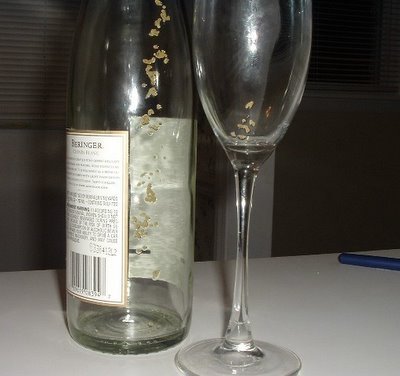
Let me start by saying that our wine does not, and should not, have a problem with tartrate crystals! I just thought that I would talk about tartrate because it's a topical subject for us at the moment - I shall explain why.....
When a wine is chilled (in your fridge for example), it can precipitate tartrate crystals - they can look pretty nasty, like sugar or even glass crystals, but in reality they are completely harmless. They are in fact potassium bitartrate, or cream of tartare (as found in baking powder) and if you find any in your wine it is still perfectly safe to drink - just pour it with a little more care, decant it, or perhaps use a strainer!
OK, so how do we prevent this? Well, actually, we don't - we make it happen in the bodega to ensure that it does not happen in your glass. This is done by passing the wine through a large freezing unit at a temperature of about -5°C, and then holding it at this temperature in special thermal tanks for between one and two weeks. The clean wine is then drawn off (racked) leaving the crystals at the bottom of the tank.
By the way, the reason that this is a topical subject is because the refrigeration equipment in our Bodega used for this process recently broke down, and cost us an arm and a leg to fix. So if you spot any one-legged wine makers hopping around, don't worry - they're quite 'armless! (sorry)